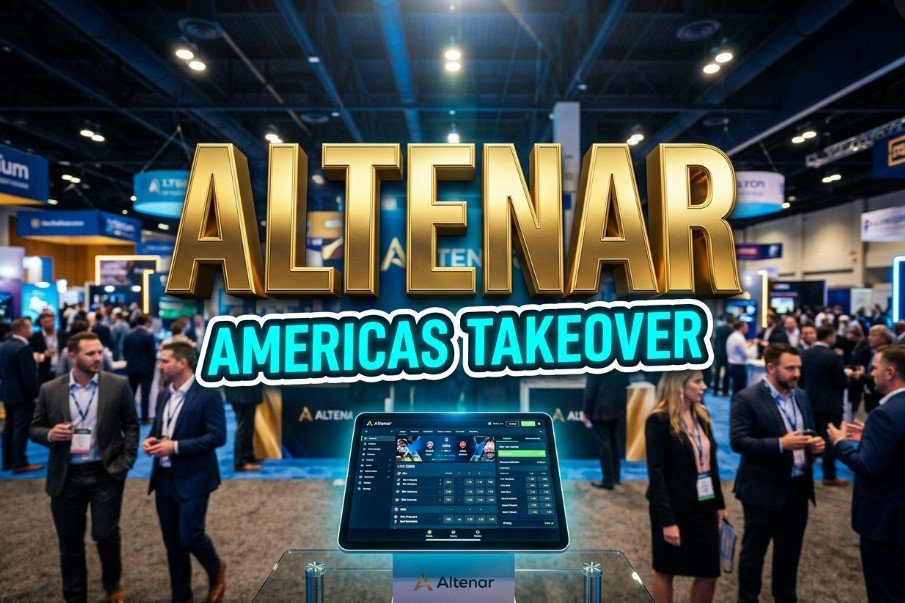
One of the hottest weeks in global sports betting just wrapped up in Fort Lauderdale. Altenar arrived at SBC Summit Americas 2026 not just as a sponsor but as a company with active deals on the table and a sharp strategy for the U.S. and Latin American markets. Yogonet sat down with Senior Sales Manager Frederico Caputi to find out what the company is chasing, what operators keep getting wrong, and why the 2026 World Cup is changing everything.
Deals, Partnerships, and What Drove Altenar to Fort Lauderdale
Caputi did not arrive at the Broward County Convention Center looking to make small talk. “Our main priority at SBC Americas is very commercial and very practical: strengthening partnerships and accelerating deals already in motion across the U.S. and LatAm,” he said plainly.
That commercial intent shaped every conversation Altenar had on the show floor. Three core topics drove the company’s agenda throughout the event:
- Modular sportsbook architecture – Operators are no longer looking for heavy, all-in-one platforms. They want flexible, API-driven components they can control, customize, and swap in or out without rebuilding the entire system.
- Speed to market in regulated environments – Especially in Brazil and emerging U.S. states, getting to market first is a genuine competitive advantage. Timing separates winners from late arrivals.
- Operational efficiency – Margin optimization, risk management, and automation are pressing concerns as tighter regulatory and tax frameworks squeeze traditional revenue models.
Altenar’s C-level executives, account managers, and Caputi himself were all present. Caputi took part in a panel discussion on June 10 at the Latin America Regulation and Compliance Stage, addressing the very challenges operators across the region are trying to navigate in real time.
The summit also delivered a significant recognition for the company. Altenar took home Sportsbook Supplier of the Year at the SBC Awards Americas 2026, adding to a run of industry recognition that included Best Online Sportsbook Provider at the SiGMA South America Awards 2026, following its Sportsbook Supplier of the Year win at the SBC Awards Latinoamérica 2024. For a company pushing hard into the Americas, the back-to-back recognition carries real weight.
The Localization Mistakes Operators Keep Making
Walk into any industry room in Latin America and the same problem comes up. A well-funded international brand arrives with a product built for European or North American bettors, drops it into a new market with a language change, and wonders why the numbers don’t move.
Caputi has watched this pattern play out and built Altenar’s regional approach around avoiding it. “Our focus is on giving local operators the tools and flexibility to compete with well-funded international brands,” he said. That means localizing across sports content, user experience, and risk management tools, not just language and currency.
The stakes in Brazil make this lesson expensive to ignore. Before regulation, users were transferring around R$33 billion ($6.6 billion) to international betting sites annually. Once the legal market launched, the industry generated roughly R$37 billion ($7.4 billion) in gross gaming revenue in year one alone. That is a market that rewards operators who understand it and punishes those who treat it as a smaller version of somewhere else.
Regulatory complexity adds another dimension. Brazil boasts mobile internet penetration reaching 86.2% in 2026, encompassing over 161 million active online users, but serving those users comes with strict rules. All transactions must flow through approved local payment methods. Crypto transactions are hugely popular in Brazil due to national currency fluctuations, and many operators are tempted to enable them. But that is a severe mistake. Crypto payments in betting are strictly prohibited by law.
Countries such as Peru, Argentina, Colombia and Mexico continue to offer strong opportunities, while others are moving closer to formal regulation, Caputi noted, pointing to a region where the direction of travel is consistent even if the pace differs market by market.
Offices and support teams in Brazil and Uruguay ensure a local service when it comes to risk management, trading and business support. That kind of grounded presence is what Caputi argues separates real localization from a strategy document nobody local has read.
Player Props, In-Play Betting, and What Bettors Want Now
The betting product that players expect in 2026 looks very different from what satisfied them even three years ago.
In the U.S. market, player props have become one of the main drivers of engagement. Player props have become one of the main drivers of engagement in the US, and this is closely linked to the long-standing popularity of fantasy sports. Bettors are already conditioned to think about individual player performance, and they now expect to combine those selections into same-game parlays. Altenar argues that sportsbooks can provide additional engagement, retention, and cross-sell opportunities, particularly through features such as player props, same-game parlays, and micro-betting markets designed to drive player activity.
In-play betting is growing just as fast. Players are no longer satisfied waiting for the final whistle. Players are increasingly craving an immediate outcome when placing a bet, rather than waiting until the end of the match. This type of betting is becoming increasingly popular, so Altenar is developing in-play sportsbook products which use relevant and accurate data in real-time to cater to the needs of the modern player.
Micro-markets complete the picture. Demand is shifting from final scores to “next event” and player props. This requires faster pricing and automated trading tools.
“Our goal is to give operators the tools they need not just to manage their sportsbook, but to truly understand and shape its performance. By leveraging predictive insights and advanced automation, we help partners reduce costs, mitigate risk, and unlock new opportunities for long-term revenue growth,” Caputi said.
World Cup 2026 Is the Biggest Sportsbook Stress Test Ever
The 2026 FIFA World Cup is already underway across the United States, Mexico, and Canada, and no sportsbook operator has seen anything quite like the pressure it is generating.
FIFA expects the 2026 tournament to reach over six billion viewers, making it the most-watched sporting event in history. With the expansion to 48 teams and 104 matches, platforms will face sustained, high-intensity pressure over a longer period. Approximately 60% of fans plan to bet, including a massive wave of first-time users who expect instant, frictionless service.
The regional picture splits in interesting ways. In LatAm, operators see strong home-nation support and country-driven betting interest. In the U.S., operators are treating soccer as a priority far earlier than usual. Historically a tier-two betting sport, it is now seeing real investment in market depth well ahead of kickoff, driven largely by player props.
Altenar has spent months positioning itself for this moment. The company strengthened its LatAm presence by integrating with a leading iGaming platform ecosystem ahead of the 2026 FIFA World Cup. The partnership with Atlaslive specifically targeted reduced implementation timelines so operators could get live quickly. With the 2026 FIFA World Cup approaching, demand for scalable and reliable sportsbook technology is expected to increase significantly. The integration positions operators to capitalise on one of the highest-volume periods in the sports betting calendar with reduced implementation timelines and a proven sportsbook solution designed to perform under peak demand.
Altenar’s Head of Sportsbook Product has described the internal preparation as centered on scalability, resilience, and user experience under extreme traffic. A World Cup stress-tests every part of a sportsbook. When a goal is scored in a knockout match, millions of bettors hit in-play markets instantly, and if data lags or the odds engine cannot reprice fast enough, operators lose margin or customers.
With 38 U.S. states now offering legal betting and favorable time zones, engagement will be continuous throughout the tournament. There is nowhere to hide when the entire planet is watching.
From the show floor in Fort Lauderdale to the pitches in Dallas and Los Angeles, every thread in sports betting right now runs back to the same truth: operators who move fast, localize properly, and build platforms that hold up under pressure will capture this moment. Those who do not will watch the window close. Altenar’s regional push, backed by fresh industry recognition and a growing list of LatAm partnerships, puts the company squarely in the race at a time when the Americas market is changing faster than anyone predicted. The World Cup will tell us who really built for this era. What do you think the biggest opportunity is right now for sportsbook operators in the Americas? Drop your thoughts in the comments below.
Leave a Reply